Case study · Cornerstone Defense
Four ledgers.
One book.
Cornerstone Defense is a mid-tier defense services contractor. Its forecast lived in four systems that never agreed with each other, and the thing reconciling them was a person. We built the system that does it instead: open pipeline, funded backlog, and the staffing to deliver both, in one place.
[ 01 ]The problem
The reconciliation was a person, not a system.
Every mid-tier contractor has the same four books. The pipeline lives in one spreadsheet. The funded backlog lives in another, keyed on contract numbers rather than opportunity names, so the two cannot be joined without a human in the middle. Staffing sits in a third. Targets sit in a fourth, usually in someone's inbox.
Each one is maintained by a different person on a different cadence, and by the end of the week there are several versions of the truth in circulation. The number leadership actually needs, what the business is worth across all of it, weighted honestly, is assembled by hand before every pipeline call.
That assembly is the failure point. It is slow, it is one person deep, and it cannot answer a question about the past.
[ 02 ]What we built
One system, reading from one source.
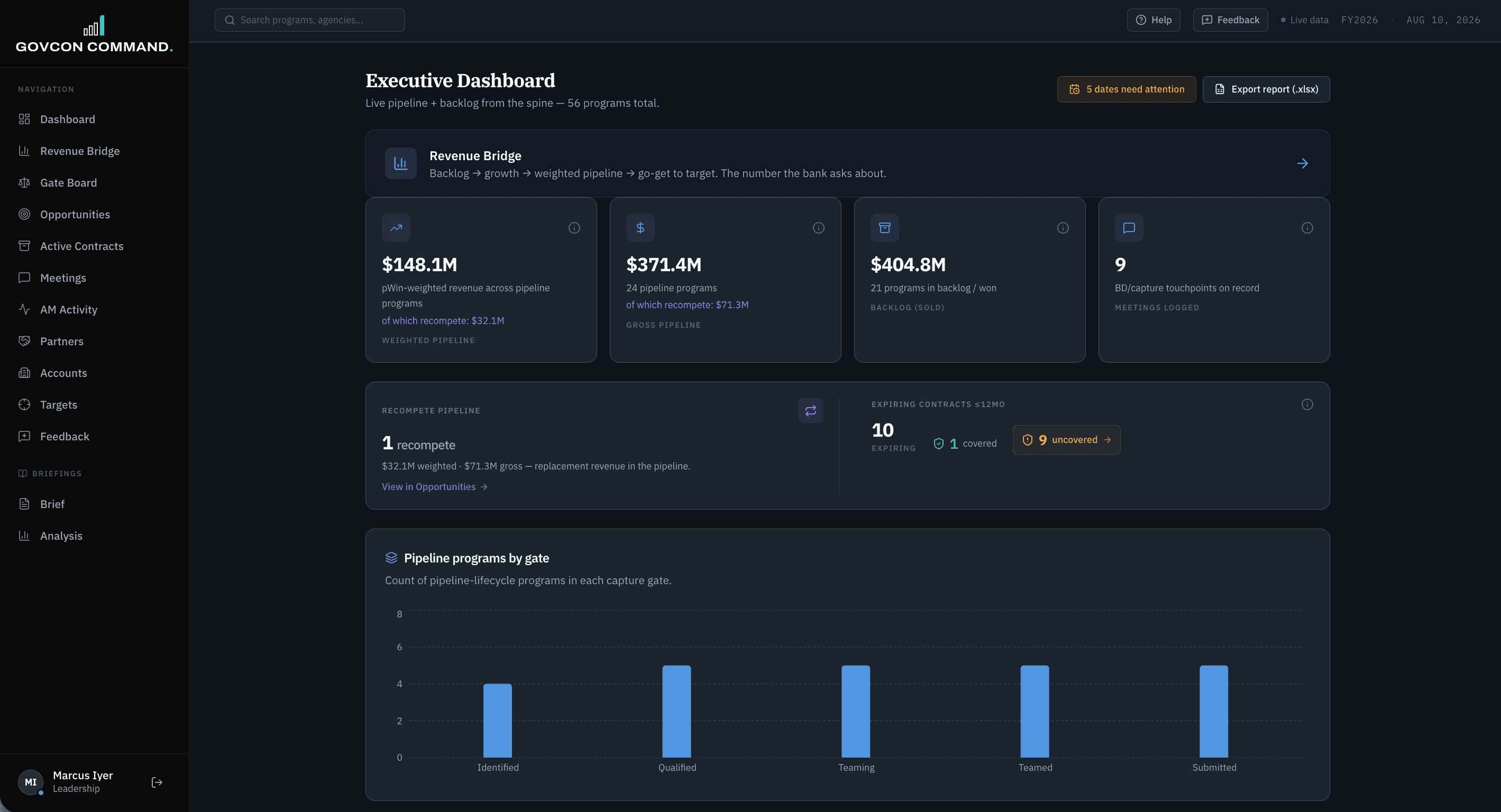
Pipeline and backlog resolve from the same source, so the executive view and the detail views can never disagree. Nothing on this page is a mockup, these are the shipping screens.
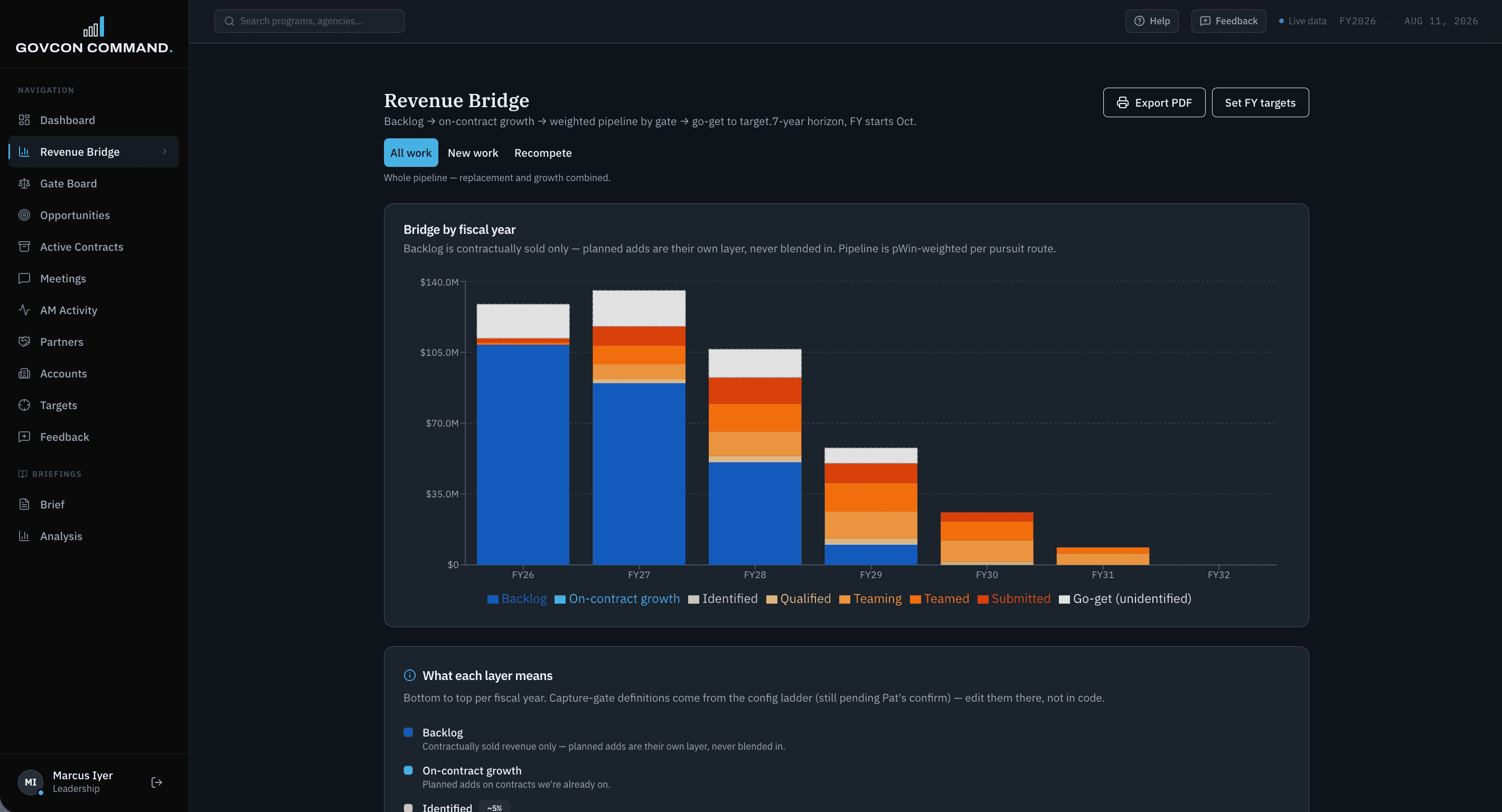
The Revenue Bridge is the number the bank asks about: funded backlog, then on-contract growth, then pipeline weighted by pWin per capture gate, then whatever is left to go get. Backlog is contractually sold work only; planned adds are their own layer and never blended in, because blending them is how a forecast quietly becomes a wish.
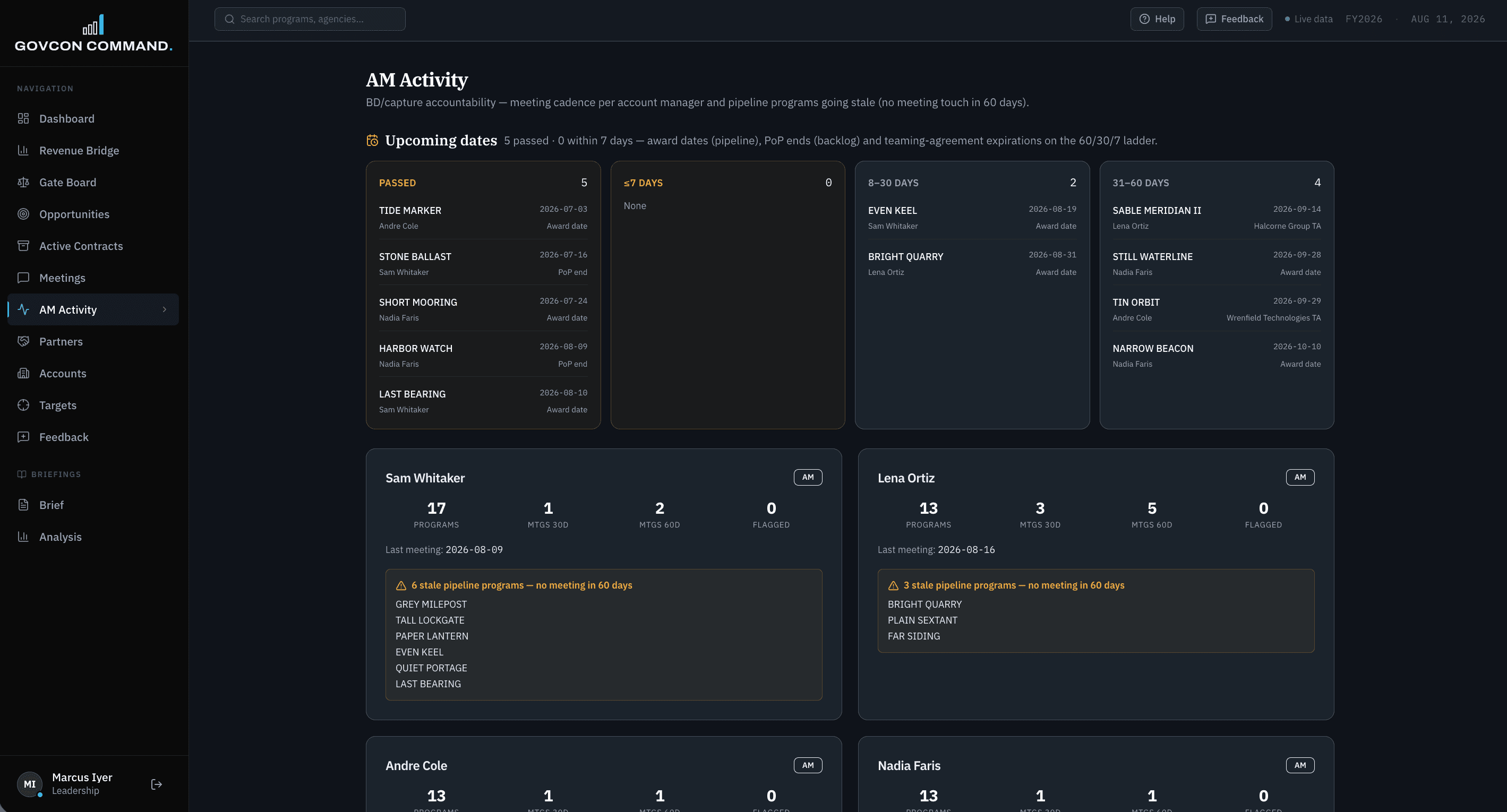
The same spine makes accountability fall out for free. Because every pursuit carries an owner and a meeting history, the system can say which programs have gone quiet, and put a date on the ones about to matter, on a 60/30/7 ladder.
[ 03 ]The client
In their words.
“We had four systems that never agreed with each other, and the thing reconciling them was a person. Pipeline, funded backlog, and the staffing to deliver both now sit in one book. When somebody asks what a pursuit was worth back in January, there’s an answer. Mike sat with our capture team, watched how the work actually gets done, and built that. I’ve bought software from companies with a hundred people that did less.”
[ 04 ]How
Built against their real book, from the first week.
No discovery deck, no six-month requirements phase. We loaded their actual contracts and pursuits early and built against them, which is the only way the edge cases surface, the pursuit routed through three primes, the recompete that is really two programs, the teaming agreement nobody logged an expiration for.
The system ships with its own guardrails because a forecast tool that can be quietly wrong is worse than no tool. Backlog never blends with planned work. Every capture-gate definition lives in config the client edits, not in code we own. An absent date renders as a dash, never a zero; a zero is a claim and an absence is not.
It is in production with the leadership team now, and the next tenants onboard through the same path that built this one.
Tell us what your team does. We'll tell you what we'd ship first.
Thirty minutes. Bring the reconciliation nobody wants to own. We'll sketch the system we'd build, the timeline, and the price.